“AHCDI Recommendations for Equity, Diversity and Inclusion Initiatives within AAPM”
The American Association of Physicists in Medicine (AAPM) created the Ad Hoc for Diversity and Inclusion (AHCDI) in order to establish recommendations that would improve equity, diversity and inclusion (EDI) within AAPM and Medical Physics. This document defines EDI, enumerates the need for EDI efforts within AAPM and Medical Physics and details the AHCDI’s list of recommendations to advance EDI within our field.
EDI Definitions
EDI concepts may not be familiar to all AAPM members, therefore we must define the meaning of the terms equity, diversity and inclusion. These terms and others have been described in our updated AAPM Diversity Statement:
“The American Association of Physicists in Medicine (AAPM) is committed to fostering and celebrating diversity, equity, inclusion and belonging in the field of medical physics.
Diversity is the range of human characteristics that make individuals unique, including differences of race and ethnicity; language; nationality; age; sex; gender identity or expression; sexual orientation; socioeconomic status; religion; and all physical abilities. We celebrate the unique perspectives and ideas offered by a more diverse medical physics workforce and recognize its capacity to drive innovation and excellence in clinical work, education, and research. We recognize that the experiences and perspectives of a more diverse medical physics workforce help identify and address the challenges faced by underserved and underrepresented patients and communities regarding radiation therapy or medical imaging procedures. We strive to increase the diversity of the AAPM membership through active outreach and mentoring.
Equity is the quality of being fair and impartial. The AAPM strives to improve equity in the field of medical physics by providing opportunities for research and clinical experiences for all medical physicists in the field, while particularly encouraging individuals of underrepresented backgrounds who may not have such opportunities otherwise.
Inclusion is the achievement of an environment in which all individuals are treated fairly and respectfully, have equal access to opportunities and resources, and can fully contribute to the organization. We value a culture of inclusivity within our organization at every level, including our staff, volunteers, leaders, and members at all levels.
Belonging is an individual’s feeling of safety, value, respect and inclusion. It is the goal of the AAPM for each member to feel a sense of belonging within the organization and the community of medical physics as a whole. By embracing our collective diversity, treating all of our members equitably, and by being inclusive with our policies, we expect all of our members to grow a sense of belonging and improve our organization with their combined input, effort and talent.“
The Case for Diversity Efforts in AAPM
EDI commitments by an organization must be motivated by the recognition that excellence is achieved by bringing together individuals and groups of diverse experiences, identities, and ideas. Science requires collaboration and innovation to answer challenging problems with novel approaches. Diversity and inclusion stimulate innovation by bringing multiple viewpoints and experiences to problem solving (1). Studies show that diverse groups can be more innovative (2,3) and generate better health outcomes for our patients (4). By 2050, 50% of the US population is expected to be comprised of Latino, African American, and other non-White background individuals, and the large health disparities that exist in these communities will only be exacerbated unless we train a new generation of health care workers, including medical physicists, to realize a more diverse and culturally competent healthcare system (5). Currently, our nation has a shortage of qualified STEM (science, technology, engineering and math) workers. By 2025, the US is expected to have 3.5 million available STEM jobs, but it is already estimated that 2 million will go unfilled due to the lack of qualified individuals (6). By making our STEM educational practices more equitable, diverse, and inclusive, we can meet the challenge of maintaining our standing in the world as a leader in STEM. Diversity is an asset that we should invest in.
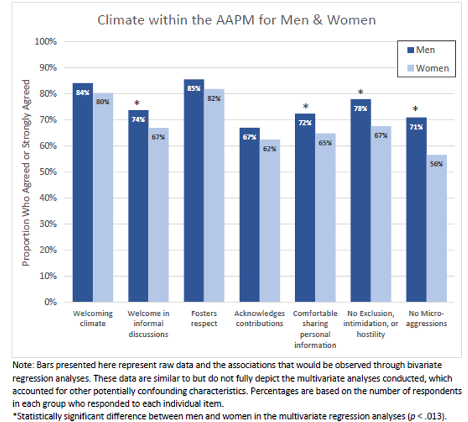
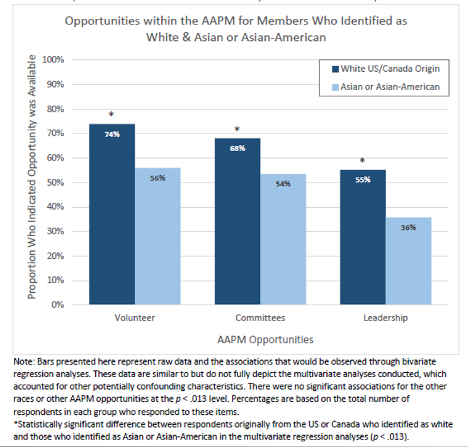
Notably, the largest compilation of data highlighting the need for EDI efforts in AAPM, is our recent executive summary from the data collected in our first ever AAPM EDI Climate Survey. Nearly 1400 full AAPM members responded to our survey and answered questions about their perceptions of inclusion, bias and other issues at their private workplace, at AAPM and at their local AAPM chapters. This data showed that there are areas of EDI that we can improve upon within AAPM at all levels. Overwhelmingly, regardless of gender, 80% of respondents found our society to be welcoming, but there were notable racial/ethnic and age differences seen. For example, only 56% of women respondents agreed or strongly agreed that they had not experienced microaggressions at the AAPM, whereas 71% of men responded the same way (Figure 1). Some of the most striking data came from Asian and Asian American respondents who indicated that they perceived themselves as having fewer opportunities to volunteer, join committees and take leadership positions within the AAPM (Figure 2). Only 56% of Asian or Asian American respondents felt that volunteer opportunities were available to them compared to 74% of White US or Canadian respondents. 54% of Asian or Asian American respondents felt like they had opportunities to join committees compared to 68% of White US or Canadian respondents. And only 36% of Asian or Asian American respondents thought leadership positions within AAPM were available to them compared to 55% of White US or Canadian respondents. Not surprisingly, historically racially underrepresented groups (including African Americans and Latino Americans) were too small (~2 % or less) for their responses to be statistically significant. Effort is needed to create focus groups for African Americans and Latino Americans in our society. Put together, this data indicates the current need for focused efforts within AAPM to address these perceptions of bias.
Recommendations for Advancing EDI in the Medical Physics Workforce
AAPM has worked on several initiatives to address the need for EDI in our field. We have made some great strides with regards to gender equity within our field. Notably, we boast 40% of our PhD Medical Physics trainees being women (7). This is an outstanding statistic when compared with most of Physics which suffers from wide gender gaps at both the trainee and faculty level. In order to ensure our efforts support the growing numbers of women Medical Physics trainees and makes way for other marginalized groups, we have created the following recommendations to advance EDI in our field:
Establish a permanent EDI committee in the Professional Council (PC):
In order for EDI efforts to have lasting change, the work must be done in the appropriate council to allow for the work to have both prominence and the resources to make it effective. Housing EDIC within PC as a full committee will accomplish these goals.
The EDIC should have the following:
EDI specialist guiding each of the efforts proposed by the EDIC
EDIC should be responsible for defining the metrics to determine the effectiveness of EDI efforts in AAPM
EDIC should develop the strategic plan for improving EDI within AAPM with guidance from AAPM Board and leadership
EDIC liaisons should come from each AAPM council to help trickle down EDI strategic policies, plans and guidance to their council members as well as inform the EDIC of new EDI-related efforts in their councils.
The current 2 subcommittees, Diversity and Inclusion and Women’s Professional subcommittees (WMRSC and WPSC), in AAPM devoted to EDI should be moved under the EDIC leadership and pulled from their previous councils to elevate the status of their efforts.
The primary goal of EDIC will be to harmonize all AAPM-affiliated EDI efforts and provide standardization and oversight. Currently, AAPM has at least 40 separate EDI efforts being carried out by various groups and individuals. These groups have no mechanism to coordinate their efforts and prevent overlap or redundancy. The EDIC will be the main means to prevent this redundancy and ensure a common EDI philosophy and vocabulary are used for all AAPM EDI efforts.
EDIC should support any and all of the strategic initiatives determined by UN69- Diversity and Inclusion.
EDIC should be given a prominent website to provide transparency to their efforts and promote its programming to the membership as well as to outside entities.
EDIC is responsible for overseeing accomplishing all of the recommendations listed in this document.
Establish EDI Training for Medical Physics:
To effectively recruit and retain underrepresented talent to AAPM and Medical Physics as a field, we must develop an EDI training strategy to ensure that all members and especially AAPM leaders are culturally-competent and inclusive. The EDIC’s EDI specialist will be instrumental in providing this training to all members.
Establish routine EDI Climate Surveys and research focused on EDI issues within AAPM:
In order to evaluate how EDI recommendations have affected change within AAPM, we must conduct routine assessments of our EDI climate. These surveys will provide the data necessary to guide new recommendations and changes to EDI programming efforts. Establishing the proper EDI climate will yield the full potential of our AAPM
membership.
Enact the “Rooney Rule” for all leadership, awards and group positions within AAPM:
The Rooney Rule is commonly used in several academic and business entities to encourage groups to be more inclusive when hiring. The Rooney Rule requires that at least one woman or racially-underrepresented person is considered for a position. AAPM has several leadership and highly sought after positions such as conference speaking engagements, Task Group positions, and others that have the perception of not being as inclusive as they could potentially be. Enacting the Rooney Rule will help pave a way for all positions to be more equitably chosen.
Establish funding and award opportunities which support EDI initiatives in AAPM for underrepresented members and trainees within Medical Physics:
Several studies have shown that the major barrier to success at the graduate level for racially underrepresented trainees in STEM is financial hardships (8). Also, our recent EDI survey showed that nearly half of respondents were concerned at the prospect of obtaining funding to pursue research. Providing funding for underrepresented medical physicists could help overcome these financial hardships and yield a robust group of underrepresented AAPM researchers. AAPM has a history of one such great award for underrepresented trainees, the DREAM (Diversity Recruitment through Education and Mentorship) summer research fellowship. We need more programs like this for more than just trainees and for longer periods of time. A fellowship for graduate school, a grant for junior faculty and an award for mentors could be helpful in diversifying our future.
Awards for underrepresented women and AAPM members as well as for allies who support the careers of such underrepresented members could help spur more AAPM members to champion EDI efforts and provide a way of formally acknowledging the hard work of those dedicated to this work.
Create and maintain a national mentorship program for underrepresented faculty and trainees in Medical Physics programs:
Several studies have shown that having a mentor from a similar background is instrumental in success for underrepresented talent (9). Due to the lack of a robust network of racially underrepresented Medical Physics researchers, students from these groups find great difficulty in finding mentorship and emotional support from scientists who share similar racial and ethnic backgrounds. AAPM should provide funding and resources to connect such scientists at the trainee and faculty level to ensure they have the support system necessary to achieve their research goals.
Recommendation Timeline
Timeframe
Activity
6 months
Create EDIC; Launch EDIC website; Initiate Rooney Rule; Provide online EDI training to membership; Publish EDI climate survey findings; EDIC will determine metrics for EDI effectiveness
1-2 years
Give all AAPM leaders EDI training; Create trainee EDI climate survey and publish findings; Provide funding and awards to underrepresented AAPM members; EDIC will audit AAPM EDI efforts; EDIC will establish the national mentorship network for women and racially underrepresented medical physicists
3-5 years
EDIC will repeat EDI climate surveys and publish findings; EDIC will evaluate AAPM based upon their EDI metrics; EDIC will present their work at national and international conferences; EDIC will publish a Task Group on cultivating an inclusive and equitable Medical Physics workforce
References:
Eugene Ivanov. The Role of Diversity in Innovation. Accessed 10/1/2020. https://www.herox.com/blog/936-the-role-of-diversity-in-innovation
Hofstra et al. The Diversity-Innovation Paradox in Science. PNAS April 28, 2020 117 (17) 9284-9291. https://www.pnas.org/content/117/17/9284
Campbell, L.G., Mehtani, S., Dozier, M.E. and Rinehart, J. (2013), “Gender-heterogeneous working groups produce higher quality science,” PLoS One, Vol. 8 No. 10, pp. e79147.
L.E. Gomez M.D., M.B.A. and Patrick Bernet Ph.D. Diversity improves performance and outcomes. Journal of the National Medical Association, Volume 111, Issue 4, August 2019, Pages 383-392, https://doi.org/10.1016/j.jnma.2019.01.006.
Lakshmi Nair, BS and Oluwaseun A. Adetayo, MD. Cultural Competence and Ethnic Diversity in Healthcare. Plast Reconstr Surg Glob Open. 2019 May; 7(5): e2219; doi: 10.1097/GOX.0000000000002219 https://www.ncbi.nlm.nih.gov/pmc/articles/PMC6571328/
Ben Weiner. Why the U.S. has a STEM shortage and how we fix it. Accessed 10/1/2020. https://recruitingdaily.com/why-the-u-s-has-a-stem-shortage-and-how-we-fix-it-part-1/
Pollard-Larkin, Julianne M, Paradis, Kelly C, Moran, Jean M, Martel, Mary K, Rong, Yi. Voices for gender equity in medical physics. J Appl Clin Med Phys. 2018 Nov;19(6):6-10. doi: 10.1002/acm2.12.12487.